

Indias became solar supercharge
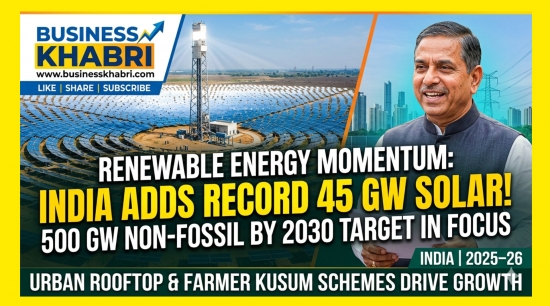
Indias Solar Supercharge: Record 45 GW Addition Lights Path to 500 GW Target
NEW DELHI— In a historic leap toward its green energy future, India has shattered previous records by adding approximately 45 GW of solar capacity in the 2025–26 fiscal year. This massive surge nearly doubles the previous years pace, firmly establishing the nation as the worlds third-largest renewable energy producer, trailing only China and the United States.
Union Minister for New and Renewable Energy, Pralhad Joshi, hailed the milestone as a testament to the vision of a Viksit Bharat (Developed India). The surge was punctuated by a breathtaking performance in March 2026 alone, which saw 6.65 GW of installations—the highest ever recorded in a single month.
The Engines of Growth: States and Schemes
The momentum was largely driven by a triple threat of leading statesRajasthan, Gujarat, and Maharashtra which accounted for the lion's share of large-scale utility projects. However, the 2025–26 boom wasnot just about massive solar parks.
Distributed Renewable Energy (DRE) emerged as a powerhouse, contributing 36% (16.3 GW)of the years total solar additions. This includes:
8.7 GW from rooftop solar installations.
7.6 GWunder the PM-KUSUM scheme, which empowers farmers to solarize irrigation pumps.
Milestone Tracker: Indias Green Tally (March 2026)
| Category | Capacity / Metric |
| Total Non-Fossil Capacity| 283.46 GW |
| Solar Capacity (Cumulative)| 150.26 GW |
| Wind Capacity (Cumulative) | 56.09 GW |
| 2025-26 Solar Addition | 45 GW |
| Renewable Share of Peak Demand| 51.5% (Record hit in July 2025) |
Policy Tailwinds and Manufacturing Muscle
The record-breaking year didnot happen in a vacuum. Several strategic policy shifts acted as catalysts:
1. Tax Incentives:In September 2025, the government slashed GST on renewable equipment from 12% to 5%.
2. Domestic Prowess:Solar module manufacturing capacity skyrocketed to 172 GW in 2026, significantly reducing import dependence and insulating the market from global supply chain shocks.
3. Battery Storage, To manage the intermittency of solar power, the government extended customs duty exemptions for lithium-ion cell manufacturing through 2028, sparking a domestic battery revolution.
The Road to 500 GW
While the 45 GW addition is a landmark achievement, the focus remains locked on the 500 GW non-fossil fuel capacity target by 2030.Having already achieved its goal of 50% non-fossil power capacity in June 2025—five years ahead of schedule—India is now doubling down on infrastructure.
The upcoming Green Energy Corridor (Phase III)and the launch of PM-KUSUM 2.0 are expected to maintain this 40–50 GW annual run rate. With the National Green Hydrogen Mission also gaining steam, India is no longer just participating in the global energy transition, it is setting the pace.
This achievement reflects Indias unwavering commitment to energy security and sustainable development. We are not just building plants,we are building a cleaner, more self-reliant future.source google, media reports.
Pralhad Joshi, is the Minister of New and Renewable Energy
For more business update stay connected with business Khabri, indias own business portal and business magazine. Its a way to boost your startup.

Blog ID : 1703
If anyone feel the content of this post is not in community guidelines, It may be considered upsetting, offensive, or sensitive. then please help us to report this.
Report to admin